Vision and values
Why "FEEDGY"?
" Feed " means to feed: we develop services based on data analysis to improve performance.
" -gy " refers to energy: our aim is to produce clean energy, made more reliable and competitive by digital technology.
Fiji, often cited as a vulnerable territory in the face of climate change, is a direct reminder of the challenges we face.
Phonetically, Fiji is the manifestation of global warming
"Feed-" means "to feed". To create services for our customers, we feed on the data we collect.
Every morning, the sun rises first on Fiji, and that's the avant-garde: the vision that fuels innovation.
"-gy" refers to "energy". The aim is to produce clean energy that can be harnessed digitally.
Our mission
Promoting green, competitive and sustainable energy through innovation
Of all the renewable energies available on the market (wind power, biomass, etc.), photovoltaics offers a number of advantages:
- A champion of lower costs, solar power is now the most competitive energy on the market.
- Silicon is the 2nd most abundant atom on earth (main component of a panel).
- A solar panel is 97% recyclable.
- The carbon footprint is low = 40 to 55 grams of CO2/kW.
- The average energy payback time = 1.5 years, depending on the technology used and the place of installation. At Feedgy, it's 1.2 years thanks to our technology.
- Can be installed in 6 to 8 months as part of a Repowering project.
- The technology is common to chips used in telephones, computers, etc. It benefits from advances in semiconductors.
Our space optimization strategy
The next challenge for photovoltaic solar energy as we know it lies in its deployment: on the back of its success, areas compatible with the installation of power plants will become increasingly scarce. Co-existence with the agricultural environment will create tensions.
What’s more, market growth and global ambitions in terms of solar development are much faster than the updating of regulations.
With demand for surface area outstripping supply, unavailability will pave the way for financial speculation that will be hard to contain in the years to come.
To meet these needs and limit this phenomenon, Feedgy has chosen to develop solutions that optimize already-used surfaces, notably through Repowering.
Notre ambition digitale est de transformer la complexité terrain en outils simples, rapides et fiables. Avec Escore, nous avons conçu des algorithmes capables de s’adapter à une grande diversité de situations réelles pour offrir des analyses techniques claires, utiles et directement exploitables. Ce qui me plaît, c’est de transformer la donnée en levier concret pour faciliter la prise de décision.— Nasra
Our ambition for competitive solar energy
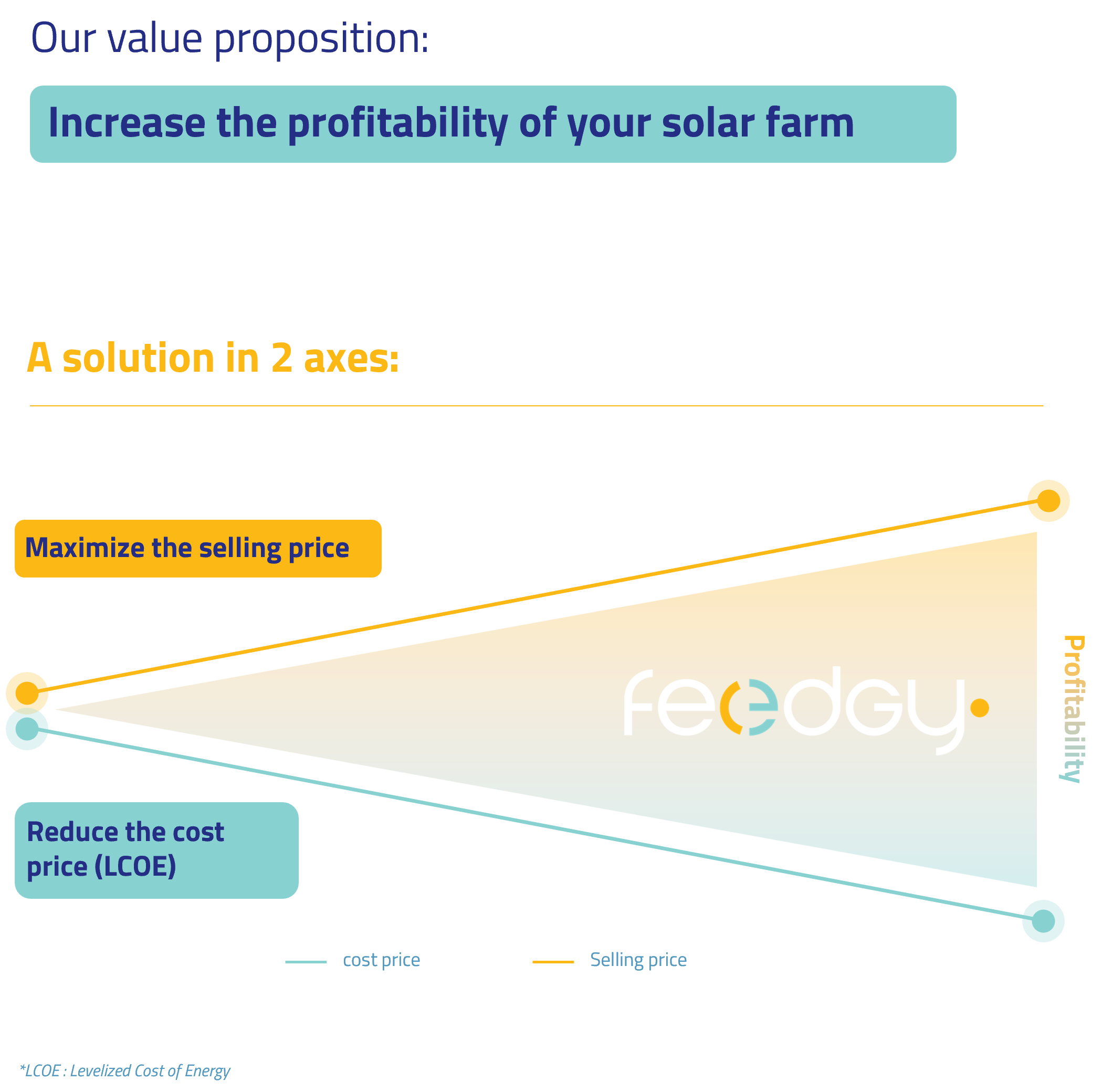
Two axes play a central role in profitability
- Sales price
By creating an attractive market, the economic principles of growing demand imply growth in value: Feedgy is helping to make the advantages of solar power ever more powerful.
- Cost price or LCOE
For years, the solar industry has lowered its initial investment costs (CAPEX), often to the detriment of the quality of materials, particularly panels. The result: less durable installations, with serious long-term consequences.
To remedy this, it is essential to reason in terms of full cost, using LCOE. LCOE (Levelized Cost of Energy) is an indicator that takes into account the lifespan of equipment and its actual performance.
Feedgy relies on sustainable equipment and invests in innovation to design new tools to optimize productivity over the entire lifespan of the plants.
Local roots for decentralized energy
Solar power can be installed on a wide variety of surfaces, making it an energy that can be adapted to any region. But each territory has its own specificities: climate, soil typology, access to the grid, regulatory framework... That's why Feedgy favors a local approach, as close as possible to farmers and local realities. Their mastery of the land and the diversity of their available surfaces enable us to develop coherent, sustainable solar projects.

Our shared values: the Feedgy charter
Our partners are committed to excellence in the solar industry and adhere to 4 key principles:
Innovation
Use advanced technologies and contribute to more sustainable photovoltaics.
Excellence
Support customers over the long term and enhance the value of existing equipment.
Quality
Respect standards, safety and the environment on every site.
Performance
Deliver measurable results and maximum performance to every customer.
Our sustainable approach
Our materials policy
As part of a repowering project, we are replacing solar panels. As an active player in the circular economy, we have chosen from the outset to participate in the re-use of the replaced equipment.
There are several possible scenarios depending on the state of the PV panel:
- Removed panel no longer usable
The degradation of the panel is too great for it to be able to produce at a satisfactory level. It is therefore necessary to recycle its components to avoid pollution and prolong the life of the materials for further use.
Feedgy works with Soren, the government-approved eco-organization for photovoltaic panel recycling in France. Soren actively participates in working groups to improve reuse and recycling, as well as in R&D projects for innovation and eco-design by manufacturers.
- Removed panel still offers interesting efficiency
Despite a lower performance than its original level (and below today's top-of-the-range equipment), a photovoltaic panel can still be used for several years if it doesn't represent an electrical risk. The owner can, for example, use it to produce solar-generated electricity for self-consumption, or entrust it to Feedgy for resale on the second-hand market. Feedgy also makes regular donations to charities for use in developing countries.
In line with its values and the principle of renewable energies, Feedgy limits repowering waste as much as possible, and contributes to a long-term economy based on solidarity.